Plays from YouTube (privacy-enhanced mode) only after you press play. Privacy
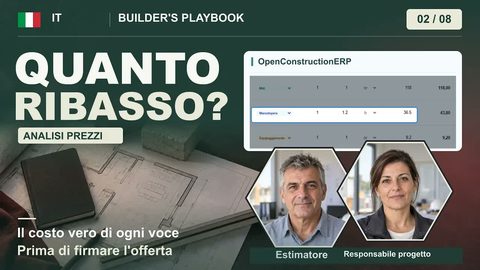
Construction Cost Database: Check a Unit Rate
Where does a unit rate come from, and how do I adjust it to my own crews and market?
A unit rate comes from a cost database item: one task with a unit and a rate built from labor, material and equipment resources, so changing a resource changes the rate. Replace the labor line's hourly rate with what your own crews cost. Regional Adjust shows one rate in another city as a quick check; it does not re-price the whole base. Treat the translated United States base as a starting point.
Every number in an estimate comes from somewhere. Find a unit rate in a construction cost database, see what it is made of, and adjust it to your market before it goes into a bid.
In this video
- What a cost database is: items with a unit and a rate, built from labor, material and equipment resources.
- Search the United States base and read one item: unit, rate, variants, and the labor, equipment and material split.
- Replace the labor rate with what your own crews cost, and use Regional Adjust to see one rate in another city.
- Use assemblies, reusable recipes for a rate, and start from the library of 25 templates by trade with MasterFormat codes.
- Load another regional base, or import your own price list.
- Honest note: the United States base is a translated base priced for the region, not a native American price book. Check its rates against your own numbers.
You will produce
A checked unit rate with your own crew labour rate, plus an assembly from the template library
Sources
Transcript
0:00 Cost databases
Every number in an estimate comes from somewhere. In this lesson you find a unit rate in the cost database, see what it is made of, and adjust it to your own market before it goes into a bid. Here is the plan. First, what a cost database is. Then how to search the American base and read one item, and what an assembly adds. After that, how to check a rate and adjust it. And finally, how to load another base or bring in your own. A cost database is a price book for construction work. Each item is one task, like installing drywall or pouring a footing, with a unit and a rate per unit. Behind that rate is a list of resources: labor hours, materials and equipment, each with its own price. When you change a resource, the rate follows. Who looks after these rates? Usually the estimator. The superintendent knows what a crew really gets done in a day, and purchasing knows what suppliers charge this month. The estimator brings both into the database, so the whole team prices from the same book.
1:01 Find a rate
OpenConstructionERP ships with 9 national cost databases, translated for 38 regions. One honest note for American builders: the United States base is one of those translated bases, priced for the region. It is not a native American price book. So treat its rates as a starting point, and check them against your own numbers. Open Cost Database from the sidebar. The tabs across the top are the bases you have loaded. Choose United States. Search works on the description, so type what you would call the work. Here, that is drywall, and the list narrows straight away. Open an item. At the top you see the description, the unit, here 100 square feet, and the rate. Below are the variants: the same work in different materials, with the lowest, middle and highest rate. That spread is your first check. Under it you find the split between labor, equipment and material, and the full resource list.
1:57 Check it
Look at the labor line. It carries hours per unit and an hourly rate. The hours describe the work itself, but the hourly rate depends on where you build. On drywall, labor is the biggest share of the rate, so this one line moves the price more than any other. Replace that number with the real cost of your crews. Regional Adjust shows the same rate in another city. Pick the nearest city on the list, here New York. Then pick a category, such as labor, and enter a base rate. You get the adjusted rate and the factor behind it. It is a quick check on one rate, and it does not re-price the whole base. Assemblies are a catalog of your own. You create them, refine them as you learn your costs, and export them to the other tools you work with. Each one is a recipe: several items and resources combined into one rate you can reuse. This reinforced concrete wall has five components: concrete, rebar, formwork, a crew and a pump. Each has a factor and a unit cost, and the drivers on the right show where the money goes.
2:59 Assemblies & more
You do not have to build every recipe yourself. The assembly library has 25 templates by trade, from concrete and masonry to drywall and roofing. Each one carries its MasterFormat code, so it lands in the right place. Open one, check its components, and preview it against a project. That is where it becomes your own assembly, with your own prices. Need a different base? Import Database lists every base family and the regions it is priced into. One click loads a region, and it appears as a new tab next to the others. You can also import your own price list as a file. It becomes a catalog of your own, right next to the built-in rates. So: find the item, see what it is made of, check the rate, and make it yours. Before the next lesson, look up three items you price every week and compare them with your own numbers. Next lesson, we start from a blank page and build a real estimate for a small duplex in Denver. OpenConstructionERP is free and open source. Download it, and start working with your own numbers today.