Work out a line total from a quantity and a net rate, and say what is inside the rate.
Decide which lines belong to a package even when they sit under different bill headings.
Keep markups out of the rates, so every layer is added once and stays visible.
1 / 7
A bill line prices one unit of work
The drawings fix the quantity.
You supply the cost of one unit.
The software multiplies the two.
Every bill line says what work, how much of it, and in which unit. Your job is to say what one unit costs. That one number is called the rate.
2 / 7
Line total = quantity × net rate
Quantity: how much work there is, in m², m or number.
Net rate: cost of one unit, before anything is added on top.
Check one line by hand before you trust a column.
Quantity120.00 m²
Net rate per m²£30.00
Line total£3,600.00
Net means the pure cost of doing the work. Nothing for the site, the head office, profit or risk is in it yet. Those come later, on top of the whole bill.
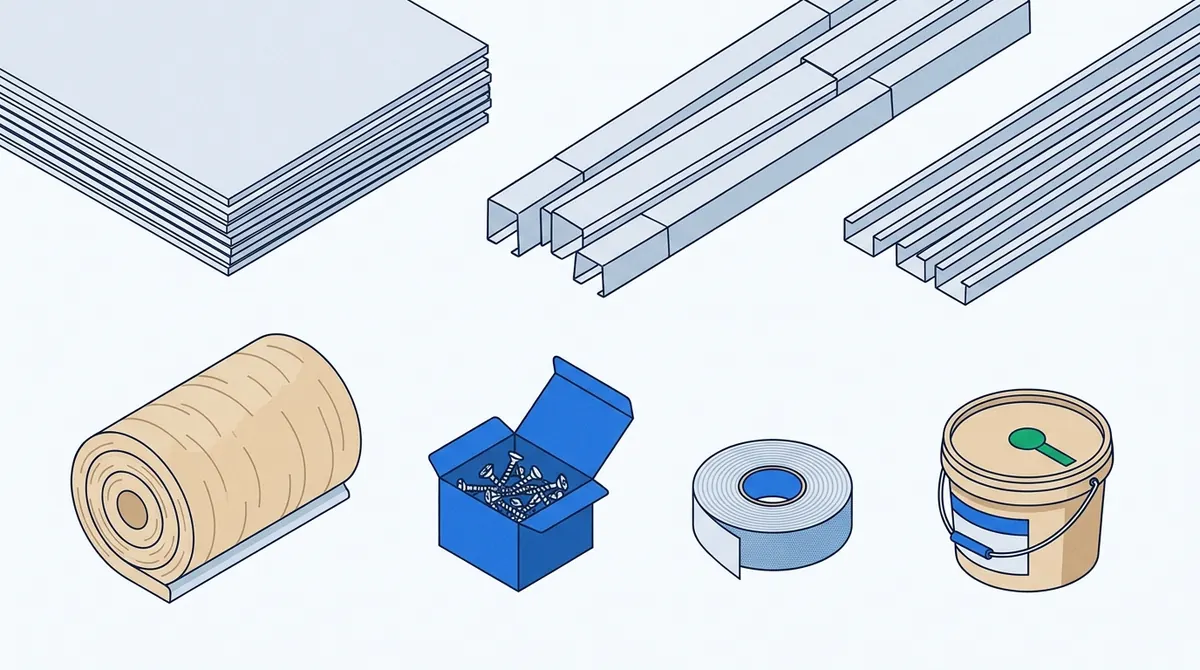
Waste: boards are cut, so you buy more than you fix.
Labour: hours per m² times the cost of an hour.
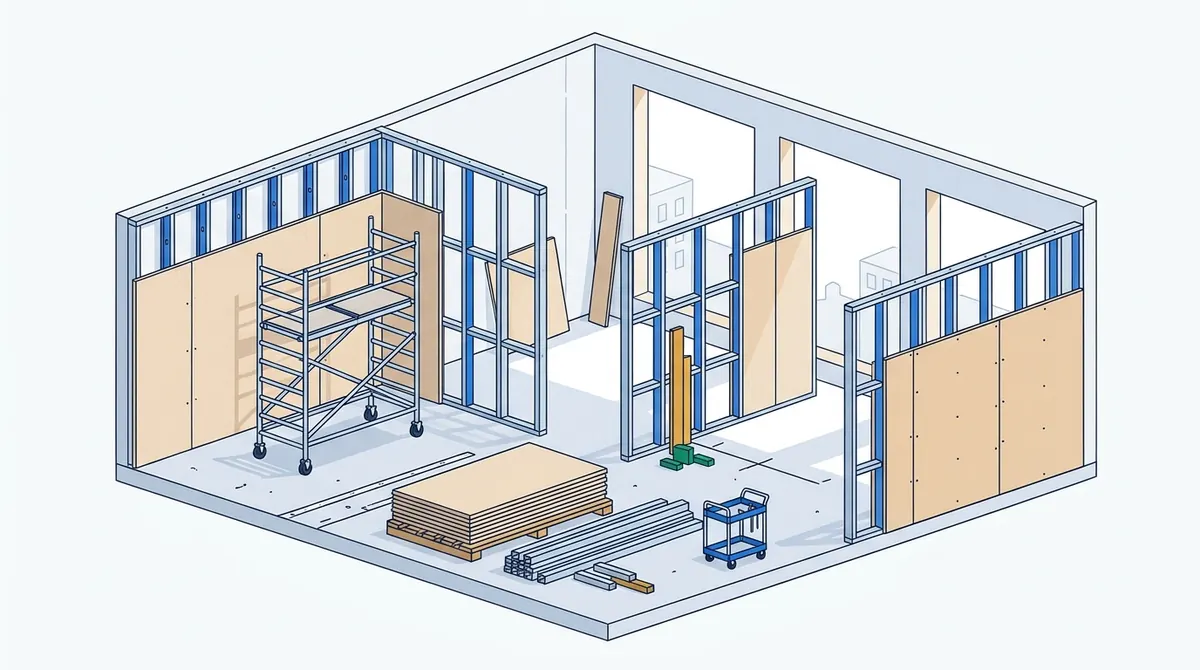
A partition is not one material. The rate carries all of it for a single square metre, including an allowance for offcuts and the time of the fixers.
4 / 7
Measure what is built
Gross area = length × height.
Deduct openings your measurement rules say to deduct.
A door comes out. The studs beside it do not: they are inside the rate.
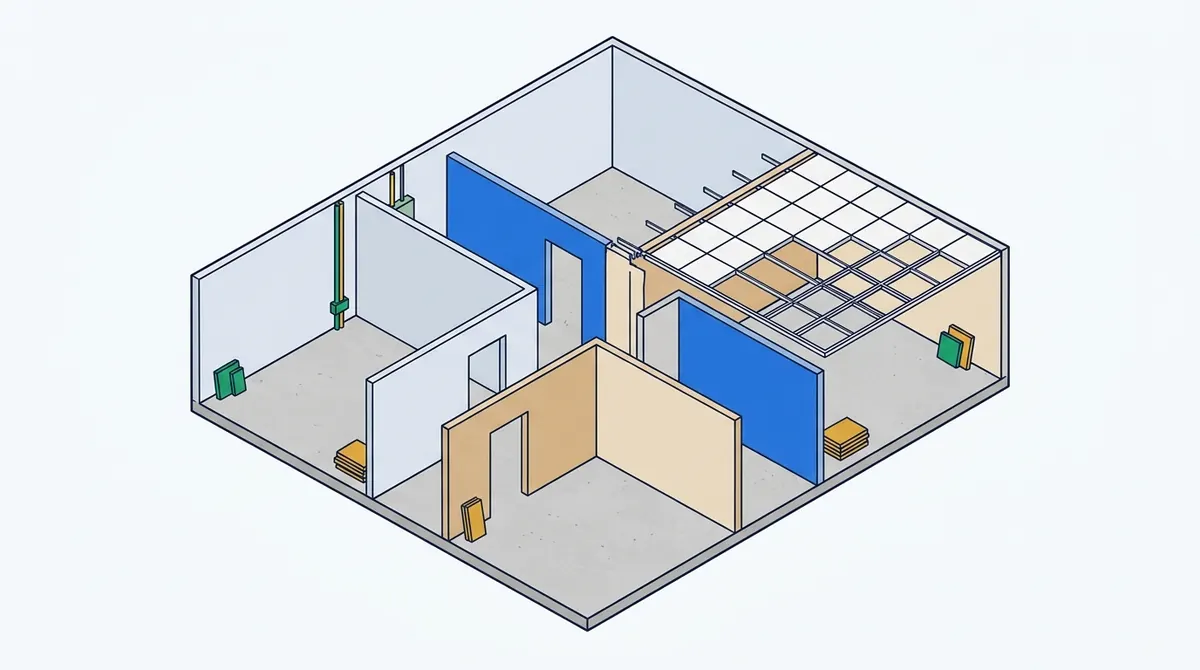
Boarded wall: priced per m²
Door opening: not boarded, so it comes out
You price what will be built. A door opening has no boards, no studs and no fixing time, so its area is taken out before you multiply by the rate.
5 / 7
Bill headings are filing, not scope
A bill is sorted by work section.
A subcontractor prices a trade, so a package can cross sections.
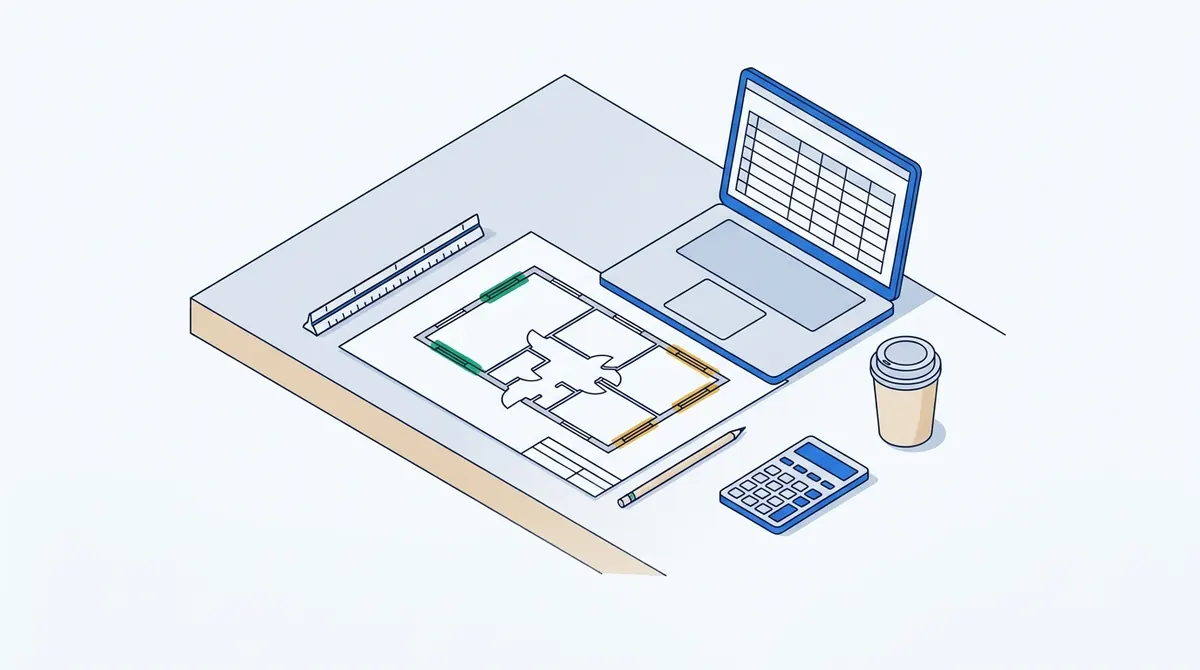
A package budget is every line of the trade, wherever it sits.
Partitions and ceilings are usually under different headings, yet one dry lining firm fits both. Add up the scope, not a heading.
6 / 7
Markups go on once, at the top
Preliminaries, overheads, profit and risk are rows of their own.
Load them into rates as well and the tender pays for them twice.
Net rates keep every layer visible and changeable.
1 Direct cost
2 Preliminaries
3 Overheads and profit
4 Risk
5 Tender
Illustrative percentages only. The point is the order: first the net cost of the work, then each layer once, on the whole bill.
7 / 7
Three questions before you type a figure
Which lines make up the package? Count them against the bill.
Is every rate net, with nothing loaded into it?
Does one line total equal quantity × rate when you do it by hand?
These three checks catch most errors in a package price: a missing line, a rate that already contains a markup, and a column you never verified.
ایرو کیز یا سوائپ
Price one wall and one ceiling
A small example with different numbers from your task. Type your answer first. A wrong guess costs nothing.
پیمانے کے مطابق نہیں
مسئلہ
Wall: 24.0 m long, 2.7 m high, one door 0.9 m × 2.1 m to be deducted.
Wall materials £18.60 per m², waste 5% on materials, labour 0.55 hours per m² at £32.00 an hour.
Ceiling: 11.0 m × 7.2 m, priced under a different heading at £28.40 per m².
Boarded wall
Door opening, deducted
Boarded wall
Door opening, deducted
مرحلہ 1 از 4
Net area of the wall
Length times height, minus the door. What area do you price?
اشارہ: Gross area first, then take the door out.
24.0 m × 2.7 m = 64.80 m². The door is 0.9 m × 2.1 m = 1.89 m². You price what is built: 62.91 m².
£18.60??
Materials £18.60
Waste ?
Labour ?
£18.60£17.60
Materials £18.60
Waste £0.93
Labour £17.60
مرحلہ 2 از 4
Net rate per m²
Materials, plus waste on the materials, plus labour. What is the net rate?
اشارہ: Waste is a percentage of the materials only, not of labour.
Waste is 5% of £18.60 = £0.93. Labour is 0.55 h × £32.00 = £17.60. Rate: £18.60 + £0.93 + £17.60 = £37.13. No overheads, no profit, no risk.
Net area62.91 m²
Net rate£37.13
Line total?
Net area62.91 m²
Net rate£37.13
Line total£2,336
مرحلہ 3 از 4
Line total for the wall
Net area times net rate. Round to the nearest pound.
اشارہ: Use the net area from step 1 and the rate from step 2.
62.91 m² × £37.13 = £2,336. This is the figure the Total column would show for this line.
1 Walls
2 Ceilings
3 Package
1 Walls
2 Ceilings
3 Package
مرحلہ 4 از 4
The whole package
The ceiling sits under another heading but belongs to the same trade. Add it to the wall. Round to the nearest pound.
اشارہ: Ceiling area times its rate, then add the wall's line total.
Ceiling: 11.0 m × 7.2 m = 79.20 m², times £28.40 = £2,249. Package: £2,336 + £2,249 = £4,585. Nothing else goes on top at this stage.
مختصراً. That is the whole method: net rate times net quantity for each line, summed across the scope. Markups are added later, once.
خود کو جانچیں
سوال 1 از 3
A partition is 12.0 m long and 2.5 m high. It has a door 0.9 × 2.1 m and a window opening 1.2 × 1.2 m, both to be deducted. What is the net area?
That is the gross area. No opening has been taken out.
Only the door came out. The window opening has no boards either.
30.00 − 1.89 (door) − 1.44 (window) = 26.67 m². You price what is built.
The openings were added instead of deducted.
سوال 2 از 3
A colleague adds 10% preliminaries to every net rate 'to be safe'. The tender also has its own preliminaries row. What happens?
The price rises for no extra scope, and you may lose the job.
Each layer belongs in one place. With net rates you can see and change every layer.
It cannot know the percentage is hidden inside a rate. It adds what you tell it.
VAT is not part of a tender sum, so it plays no role here.
سوال 3 از 3
Materials cost £22.00 per m². Waste is 5% on materials. Labour is 0.40 hours per m² at £30.00 an hour. The quantity is 50 m². What is the net line total?
Rate: 22.00 + 1.10 + 12.00 = £35.10 per m². Times 50 m² = £1,755.00.