







































Stage 2 of 7 · Design
Embodied carbon and sustainability
Calculate the carbon in materials and construction, and use it to choose between options.
- CoursesCourse in preparation
- Free videosNo video yet
- Output
- Embodied carbon assessment and sustainability report
- Module
- Sustainability, assets and operations
- Documents
- Standards and references
What it is
Embodied carbon is the greenhouse gas emitted in making, transporting and installing building materials, and later in maintaining, replacing and demolishing them. EN 15978 divides the life cycle into modules: A1–A3 product stage, A4 transport to site, A5 construction, B use stage, C end of life, and D benefits and loads beyond the system boundary. Structure and envelope usually carry most of the upfront carbon.
An assessment multiplies material quantities from the estimate or model by emission factors from EN 15804 EPDs or generic databases such as ICE. Done early, it compares design options while change is still cheap. Done at completion, it reports what was actually built. Clients, planning authorities and some national regulations now require it.
Who does it
- Sustainability consultant
- Runs the assessment and advises on lower-carbon options.
- Estimator / QS
- Provides quantities and checks material specifications.
- Designers
- Choose structural systems and materials and test alternatives.
- Contractor's procurement team
- Obtains product EPDs and records delivered materials.
- Client
- Sets carbon targets and reporting requirements.
How it runs
Set scope and targets
Agree the modules covered, the reference study period and any target or limit value.
Extract quantities
Take material quantities from the BOQ or model, grouped by building element.
Assign emission factors
Use product-specific EPDs where known and generic data, such as ICE, where not.
Calculate and compare
Calculate carbon by module and element and compare design options.
Update through procurement
Replace generic data with the EPDs of the products actually bought.
Report
Issue the assessment to the agreed method and record assumptions and data sources.
How it differs by country
- United Kingdom
- The RICS professional standard Whole life carbon assessment for the built environment (2nd edition, 2023) sets the method most practitioners use. The Greater London Authority requires whole life carbon assessments for referable planning applications.
- France
- RE2020 sets regulatory limits on the life-cycle carbon of new buildings, using a dynamic calculation method and environmental data from the INIES database.
- Netherlands
- The MPG (MilieuPrestatie Gebouwen) sets a maximum environmental performance score for new buildings, calculated with data from the national environmental database.
- Denmark
- The Danish building regulations set limit values for life-cycle carbon emissions of new buildings, and these limits are being tightened over time.
- International
- EN 15978 defines the assessment method for buildings and EN 15804 the rules for construction product EPDs. Building Transparency's EC3 tool is widely used to compare products using EPD data.
Common mistakes
- Mixing modules, such as comparing an A1–A3 figure with a whole life figure.
- Using generic factors for concrete and steel when product EPDs are available.
- Missing quantities for services, finishes or temporary works.
- Not stating the reference study period and assumptions.
- Running the assessment only at the end, when design choices are fixed.
- Including module D benefits in the headline result instead of reporting them separately.
In OpenConstructionERP
Module: Sustainability, assets and operations
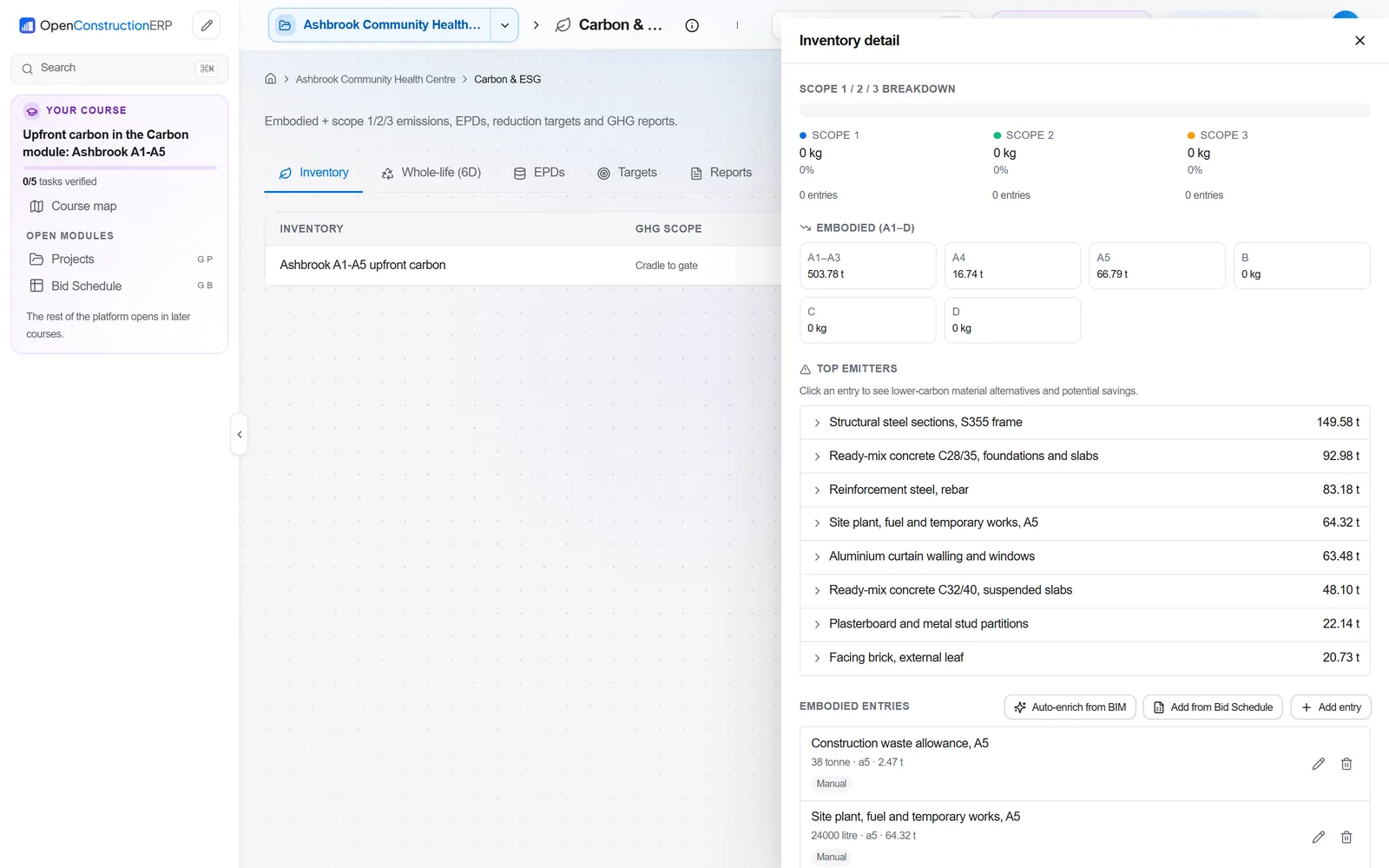
The Sustainability, assets and operations modules support carbon work. Carbon & Sustainability calculates embodied and operational carbon, holds an EPD database and produces sustainability reporting. ESG Site Performance tracks site energy, water, waste, local labour and safety against targets, which teams use as evidence for construction-stage impacts. Off-site / Prefab / DfMA tracks manufactured units from production to installation, helping record what was actually installed for the as-built assessment.
Carbon & Sustainability · ESG Site Performance · Off-site / Prefab / DfMA
The app runs at openconstructionacademy.com/app for course learners.
Free videos
There is no free video on this process yet.
Courses
Course in preparation
Practise it in OpenConstructionERP
The free videos explain the process. The full course lets you run it yourself in the ERP, task by task.