OpenConstruction Academy
Logga in / Registrera
SV

Teori före uppgift 2 · 10 min

From direct cost to a tender sum

Bygg upp anbudssumman

Efter den här lektionen kan du

  1. Name the layers between direct cost and a tender sum, and say what each one pays for.
  2. State the base of each percentage, and see how the base changes the sum.
  3. Remove rows from a template that belong to someone else's budget.
1 / 5

Direct cost is not yet a price

Direct cost is what the measured work costs to build: labour, materials, plant and subcontractors. A tender must also pay to run the site, to keep the firm going and to carry risk, and it has to leave a profit. These are layers added to direct cost, one after another.

Exempel. In this example preliminaries are a fixed sum, overheads are 6% and profit 4% of direct cost, and risk is 2% of everything above it. Direct cost of £800,000 becomes a tender of 995,520 pounds.
£800,0001+£96,0002+£48,0003+£32,0004+£19,5205£995,5206
  • 1 Direct cost
  • 2 Preliminaries
  • 3 Overheads
  • 4 Profit
  • 5 Risk
  • 6 Tender
2 / 5

Preliminaries: the cost of time

Preliminaries are site-wide costs that belong to no single bill line: site management, cabins, hoarding, crane, access scaffold, insurance. They run with the programme, so the honest way to price them is from the programme: weeks times the weekly cost. A percentage of direct cost is only a placeholder.

Exempel. Weekly cost £2,200 + £600 + £1,400 = 4,200 pounds. Over 40 weeks that is 168,000 pounds as a fixed sum. If the programme grows by 5 weeks, a fixed sum built this way rises by 21,000 pounds. A percentage of direct cost would not move at all.
£2,200£600£1,400
  • Site team per week £2,200
  • Cabins and welfare per week £600
  • Crane per week £1,400
3 / 5

Overheads and profit: percent of what?

Overheads pay for the head office, whatever the number of jobs. Profit is what the firm earns. Both are usually percentages, and a percentage means nothing until you say what it is taken of: direct cost alone, direct cost plus preliminaries, or a running total. Pick one base and say it.

Exempel. The same 8% gives 64,000 pounds on direct cost and 71,680 pounds on direct cost plus preliminaries. The choice of base moves the tender by 7,680 pounds, and the percentage never changed.
8% of direct cost
£64,000
8% of direct cost plus preliminaries
£71,680
4 / 5

Risk: where it sits in the stack

A risk allowance covers what could go wrong and cannot be priced line by line. If it is the last row and is taken of the running total, it protects everything above it, including your own overheads and profit. Taken of direct cost alone it is smaller. Firms differ; what matters is that the base is stated and the same for every bid.

Exempel. 2% of direct cost is 16,000 pounds. 2% of the running total is 19,520 pounds, a difference of 3,520 pounds.
2% of direct cost
£16,000
2% of the running total
£19,520
5 / 5

Rows that belong to someone else

A template for a country often carries rows for several parties. A design development risk row is an allowance in a client's cost plan, because the client owns the design. VAT is not part of a contract sum at all: it is added to each invoice. In your tender, keep the rows that are your costs and delete the rest.

Exempel. Test each row with one question: whose budget does this protect? If the answer is not your firm, it does not belong in your price.

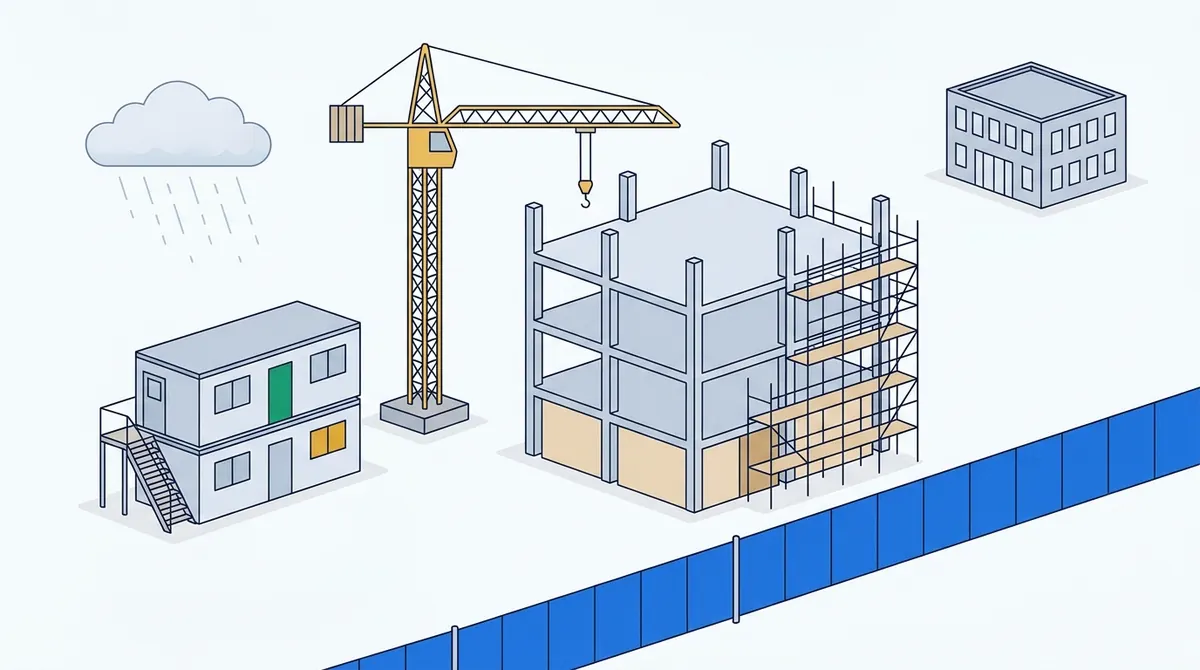
Where each layer lives on a site

Tap a numbered point. Each one shows what the layer pays for and which row of the tender it becomes.

An illustrated construction site: site cabins, a tower crane, a blue hoarding fence, a concrete frame with scaffolding, a distant head-office building and a rain cloud.
  1. The site manager's office and the welfare cabins exist for as long as the job runs. Their cost depends on the programme.

    Var den finns i din kalkylPreliminaries, as part of a weekly cost times the number of weeks.
  2. A crane is hired by the week, whatever it lifts. It serves every trade on site, so it cannot be charged to one bill line.

    Var den finns i din kalkylPreliminaries: plant that serves the whole job.
  3. Hoarding, scaffold and temporary works make the site safe and secure. They are needed for the job, not for a single item of work.

    Var den finns i din kalkylPreliminaries: temporary works.
  4. Accounts, estimators, directors and the office lease are paid whether or not this job exists. Each job carries a share.

    Var den finns i din kalkylOverheads: a percentage, with a stated base.
  5. Concrete, blockwork, finishes and services are the measured permanent work. This is what the bill lines price.

    Var den finns i din kalkylDirect cost: the sum of the priced bill lines.
  6. Weather, ground conditions and late information can cost money, and nobody can say in advance which one will. Risk is a deliberate allowance for that.

    Var den finns i din kalkylRisk: the last row, on a stated base. Profit sits beside it: it has no place on site, it is what is left for the firm.

Testa dig själv

Fråga 1 av 4

Direct cost is £600,000. Preliminaries are a fixed £72,000. Overheads 5% and profit 5%, each of direct cost. Risk 2% of the running total after those four. What is the tender sum, before VAT?

Running total before risk: 600,000 + 72,000 + 30,000 + 30,000 = 732,000. Risk 2% = 14,640. Tender: £746,640.
Fråga 2 av 4

The programme grows by five weeks. Which way of pricing preliminaries reacts?

  • Five more weeks means five more weeks of cabins, crane and site team. The sum follows the programme.

  • Direct cost does not change when the programme does, so the percentage stays put while the real cost rises.

  • They are fixed in the tender, not in life. That is why they are priced from a programme you can defend.

Fråga 3 av 4

Which of these belongs in overheads, not in preliminaries?

  • A crane serves this job only and runs with its programme. That is a preliminary.

  • Paid because of this job and for its duration. A preliminary.

  • It exists whatever jobs are running, so each job takes a share as overhead.

  • That is a measured material: direct cost, inside a bill rate.

Fråga 4 av 4

The UK template has a 'VAT 20%' row and your firm's tender form says 'ex-VAT'. What do you do with the row?

  • VAT is not your income or your risk. It is collected for the tax authority, so it is not part of the price.

  • The contract sum is stated ex-VAT and VAT is charged on each payment.

  • Position does not fix it. The row is outside a tender sum wherever it stands.