







































Course introduction · 3 min
Rate analysis to CPWD practice (India)
You are the estimating engineer for a district council: you prepare the detailed estimate, the priced list of all work, for a primary health centre before it goes to tender. In four tasks you build the rates for brickwork and reinforced concrete (RCC) from analysis sheets, the method of India's Central Public Works Department (CPWD), then price the whole estimate.
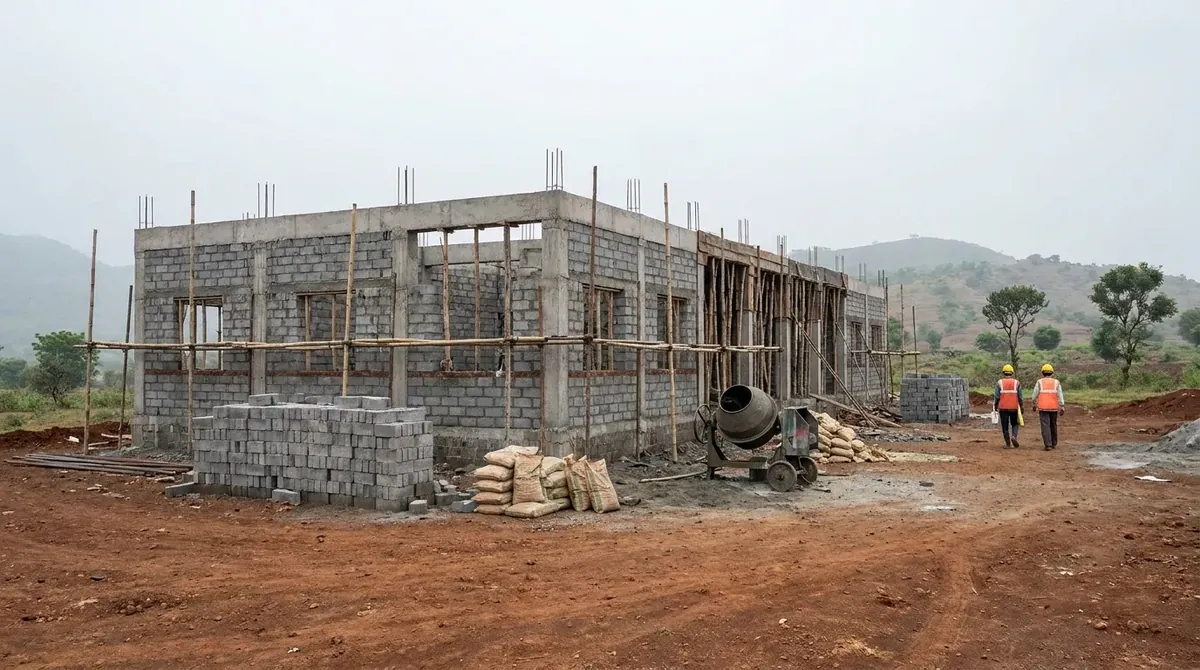 Fictional project
- Building
- Single-storey primary health centre in a village
- Contract
- Public works contract, priced from the schedule of rates (the government's published rates) with a station cost index, the percentage for this location
- Currency
- Rupees, worked before GST
- Work in the ERP
- 4 tasks, about 2 h 20 min
Who hands what to whom
Every arrow is a document that reaches your desk or leaves it, and the task where that happens.
Comes to you
- Site engineerSends the analysis sheets
- Brickwork analysis sheet and two brick offersTask 1
- RCC M25 sheet and bar bending scheduleTask 3
- Two contractorsQuote line 2.1 their own way
- Quote A and quote BTask 2
Goes from you
- Brickwork rate per m³Task 1
- Complete rate and the gap to quote ATask 2
- RCC rate and the reinforcement lineTask 3
- Estimate totalTask 4
Your route through the job
Three tasks to build a rate, one to price the estimate. Brickwork comes first because the two later steps reuse its logic. Start with task 1: in the Bill of Quantities you cost 10 m³ of brickwork from the cheaper brick source.
Analyse the work
Task 1 · 35 min
Brickwork: the cheaper source, then the cost per m3
- You produce
- Cost of 10 m³ of brickwork from the cheaper brick source
- Document
- Analysis sheet and two brick offers
- In the ERP
- Bill of Quantities
Analyse the work
Task 2 · 30 min
Two contractor quotes against the CPWD rate
- You produce
- The CPWD rate on line 2.1, and how far quote A sits below it
- Document
- Two contractor quotes
- In the ERP
- Bill of Quantities
Concrete and the estimate
Task 3 · 40 min
RCC M25: what belongs in the concrete rate
- You produce
- RCC M25 rate on line 2.2, reinforcement kept on line 1.3
- Document
- RCC sheet and bar bending schedule (the list of every steel bar)
- In the ERP
- Bill of Quantities
Concrete and the estimate
Task 4 · 35 min
Schedule items with the cost index, analysed items without
- You produce
- The estimate total, Direct Cost
- Document
- Schedule base rates and the station cost index
- In the ERP
- Bill of Quantities
From an analysis sheet to an estimate
A rate is built in layers, and each layer has one place to go. Task 4 shows which rates take the cost index and which do not.
Blue is what the task adds; grey is carried over from before.
In short. Price the cheaper source delivered. Water first, then profit and overheads on the sum. Pay steel once. Index the schedule, not the analysis.