







































Course introduction · 3 min
Measure to IS 1200 and bill it (India)
You are the billing engineer of the contractor building a teaching block for a central institute: you measure the work done and bill for it. In five tasks you measure one brick wall by the Indian standard IS 1200, price the bill at schedule rates, the government's published rates, raise the first running account (RA) bill, the monthly part payment, and work out what the institute actually pays after deductions.
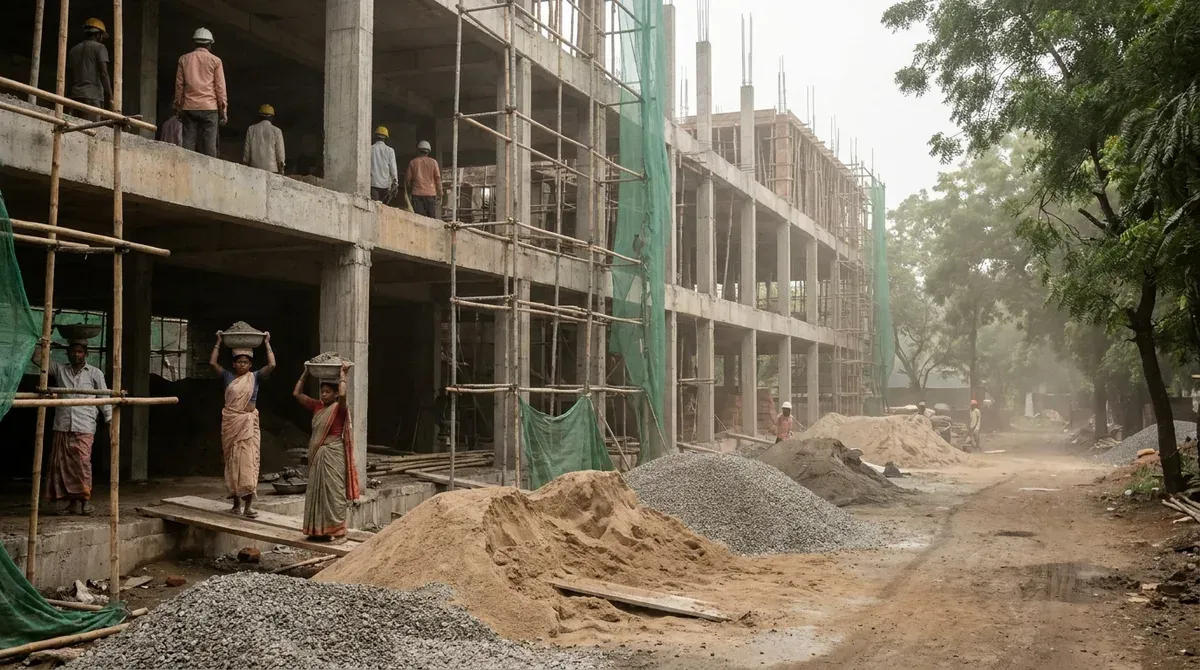 Fictional project
- Building
- Ground plus two storey teaching block of a central institute
- Contract
- CPWD General Conditions of Contract 2023; bidders quote one percentage above or below the schedule of rates
- Currency
- Rupees, tendered rates inclusive of GST
- Work in the ERP
- 5 tasks, about 2 h 45 min
Who hands what to whom
Every arrow is a document that reaches your desk or leaves it, and the task where that happens.
Comes to you
- Project ManagerYour firm, your side
- Wall CW1 and its opening sizesTask 1
- The tender percentage the company quotedTask 3
- Engineer-in-ChargeInstitute Engineering Wing
- Cost index notified for the stationTask 3
- RA Bill 1, passed for paymentTask 5
Goes from you
- Brickwork measured to IS 1200Task 1
- Plaster measured to IS 1200Task 2
- RA Bill 1 and what is left to billTask 4
- Recoveries and the amount payableTask 5
Your route through the job
Two tasks measure, two price and bill, one gets the money in. Start with task 1: in the Bill of Quantities you measure the brickwork volume of wall CW1 for line 2.3.
Measure the wall
Task 1 · 35 min
Measure the brickwork: which openings come out
- You produce
- Brickwork volume of wall CW1 on line 2.3
- Document
- Elevation of CW1 with seven openings
- In the ERP
- Bill of Quantities
Measure the wall
Task 2 · 35 min
Plaster on the same wall: three thresholds, not one
- You produce
- Plaster area of the same wall on line 3.1
- Document
- The same elevation, plaster on both faces
- In the ERP
- Bill of Quantities
Price and bill
Task 3 · 35 min
Price the abstract: base rates, cost index, tender percentage
- You produce
- Gross value of the abstract (the priced summary of all lines)
- Document
- Schedule base rates and the station cost index
- In the ERP
- Bill of Quantities
Price and bill
Task 4 · 30 min
Running account bill 1 in the ERP
- You produce
- RA Bill 1 (the first part payment) in five lines, the share billed and the balance
- Document
- Contract: tendered amount and Schedule 'F'
- In the ERP
- Contracts
Get paid
Task 5 · 30 min
Recoveries: security deposit, welfare cess, GST
- You produce
- The amount the institute pays
- Document
- Passed RA Bill 1 and the tax position
- In the ERP
- Contracts
From one wall to one payment
Each task adds one layer to the same money. The new layer is in colour; what it sits on is grey.
Blue is what the task adds; grey is carried over from before.
In short. Brick and plaster have different thresholds. Index first, tender percentage on top. Bill against the tendered amount. Deposit on the gross, cess and tax at source on the value without GST.