







































Course introduction · 3 min
Bill-of-quantities pricing in practice: GB/T 50500-2024 (China)
You are the contractor's cost estimator (造价员) on a county primary school in China: you work out the price the builder bids and what it is paid. In five tasks you build the bid from all-in unit rates to VAT, draw the first progress payment and reprice two items whose quantities moved past the limit the contract allows. The rules come from GB/T 50500-2024, China's national standard for pricing with a bill of quantities.
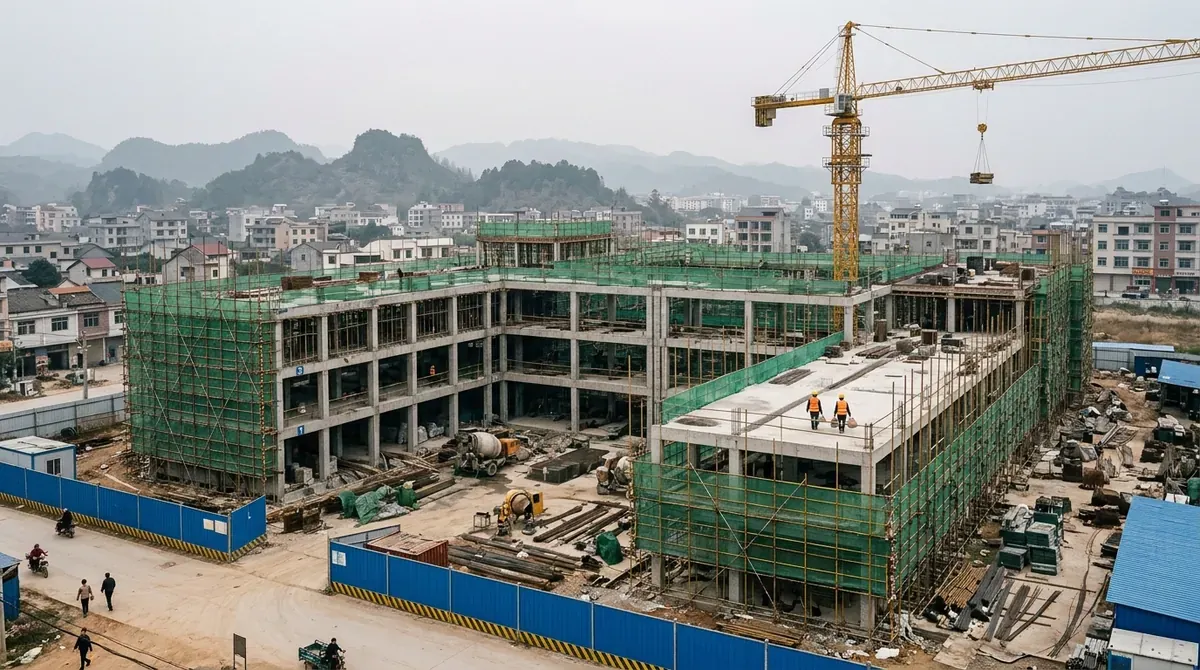 Fictional project
- Building
- Teaching block, three-storey concrete frame
- Pricing
- Bill of quantities, GB/T 50500-2024
- Contract
- Unit-price contract after a public tender
- Work in the ERP
- 5 tasks, about 3 h 40 min
Who hands what to whom
Every arrow is a document that reaches your desk or leaves it, and the task where that happens.
Comes to you
- Tender documentsBill, norms, contract terms
- Norm quantities and pricesTask 1
- Measures and the safety fee rateTask 2
- Fee and VAT termsTask 3
- A colleagueDrafted payment 1
- Draft with the bases swappedTask 4
 Supervising engineer (监理)Verifies quantities and progress
- Work measured in period 1Task 4
- Re-measured quantitiesTask 5
 YouCost estimator (造价员), contractor
Goes from you
- The priced bidTask 3
- Progress payment 1Task 4
- Rate adjustment for two itemsTask 5
 County Education BureauEmployer, pays
The project and the people are fictional. Portraits are generated.
Your route through the job
Three tasks price the bid in March, one draws the first payment in August, one reprices quantities at the December review. Each works on the same bill. Start with task 1: in the Bill of Quantities you build the all-in unit rates for beams and columns.
Bid
Task 1 · 45 min
Composite unit rate: beams and columns
- You produce
- All-in unit rates (综合单价) for beams and columns
- Document
- Norm quantities, prices with VAT, fee rates
- In the ERP
- Bill of Quantities
Bid
Task 2 · 40 min
Measured works and measures
- You produce
- Measures items (temporary works such as scaffold) and the work-safety measures fee
- Document
- Scaffold and formwork rates, the fee's base
- In the ERP
- Bill of Quantities
Bid
Task 3 · 40 min
VAT on the three sections
- You produce
- VAT on the three bill parts as a markup, with no separate 规费 (fees set by the government)
- Document
- The contract's pricing and tax terms, a colleague's draft
- In the ERP
- Bill of Quantities › Markups
Payment
Task 4 · 50 min
Interim payment and advance recovery
- You produce
- Advance recovery and the amount payable for period 1
- Document
- A colleague's draft and the contract terms
- In the ERP
- Contracts › Progress Claims
Review
Task 5 · 45 min
Quantity deviation over 15 %
- You produce
- Adjusted rates and the variation amount
- Document
- Quantities re-measured after completion
- In the ERP
- Variations
Every charge on its own base
The first three bars are the bid as it grows, one task at a time. The fourth is one period of work, split into what is paid and what is kept.
Blue is what the task adds; grey is carried over from before.
In short. Price net of VAT, put each fee on the base the contract names, and never swap the bases of advance recovery and retention.