







































Stage 6 of 7 · Build
Cash flow and forecasting
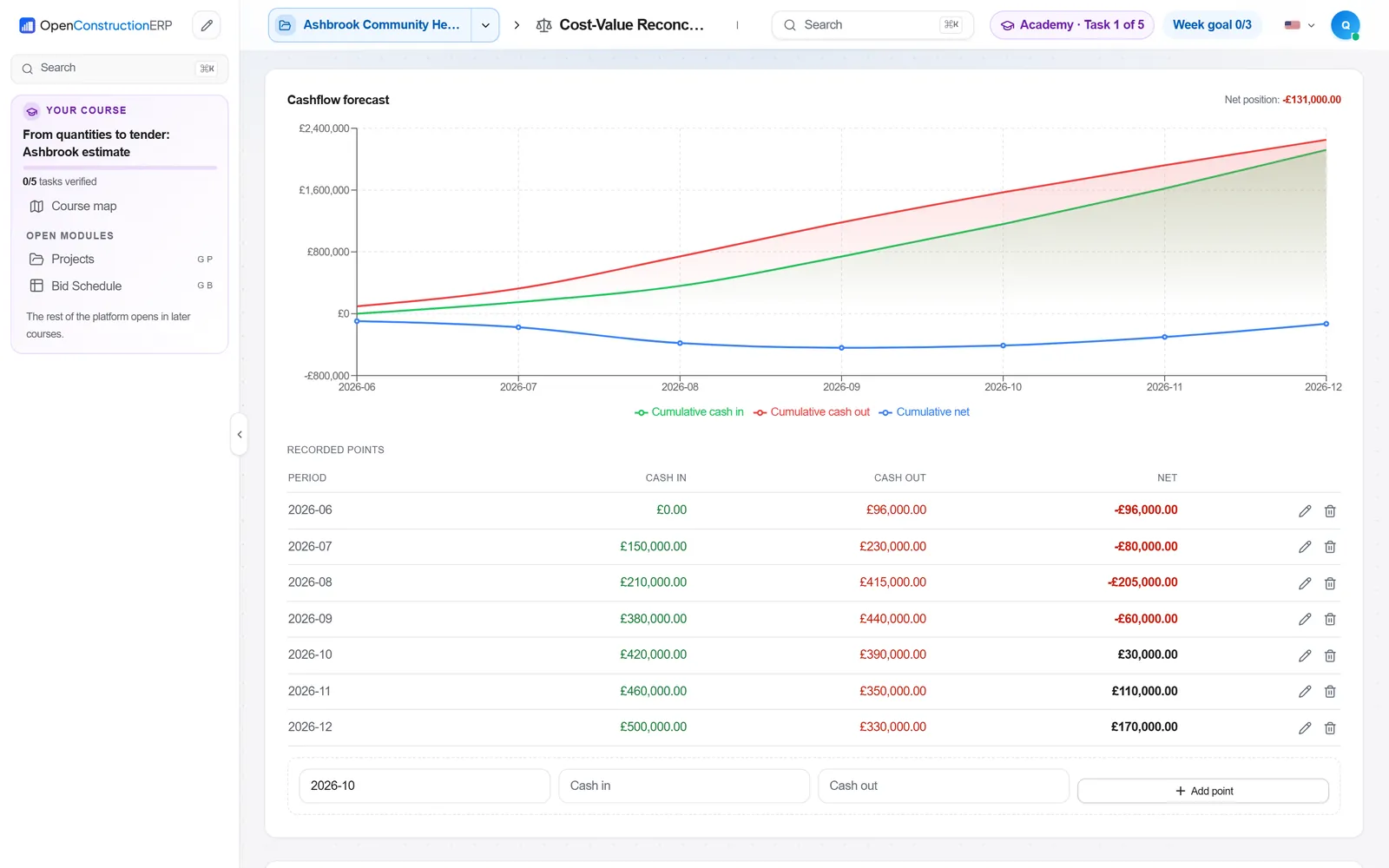
Forecast money in and out month by month and see in which month the project needs funding.
- ProfessionalCash flow forecast on Ashbrook: S-curve, payment terms and retention
- Free videosNo video yet
- Output
- Monthly cash flow forecast and cost-value report
- Module
- Cost control, EVM and risk
- Documents
- Standards and references
- —
What it is
Cash flow forecasting predicts when money will come in from the client and go out to subcontractors, suppliers and staff, month by month, until final account. It is built from the programme, the priced bill or cost plan, payment terms in each contract and retention rules. A contractor can be profitable on paper and still fail because valuations are certified late or retention is held for years.
The forecast is refreshed every month against actuals. The project team compares certified value with cost incurred, explains variances, and moves future income and expenditure to reflect the current programme. The result feeds board reporting, bank facilities and decisions such as whether to accelerate, chase overdue payments or renegotiate supply chain terms.
Who does it
- Commercial manager / QS
- Owns the forecast, the monthly valuation and the cost-value reconciliation.
- Project manager
- Confirms programme progress and upcoming work that drives the timing of costs and income.
- Planner
- Provides the updated programme and resource-loaded activities behind the S-curve.
- Finance team
- Records actual payments and receipts and consolidates project forecasts at company level.
- Client's cost consultant
- Assesses applications for payment and issues the valuation that determines income.
How it runs
Set the baseline
Spread the contract sum and the cost budget over the baseline programme to produce income and expenditure S-curves.
Apply payment terms
Shift each line by its payment cycle: client certification and payment periods, subcontract terms, retention percentage and release dates.
Record the month's actuals
Enter the certified valuation, invoices received, payments made and accruals for work done but not yet invoiced.
Reconcile cost and value
Compare value earned with cost to date and explain margin movement by package, including variations and claims not yet agreed.
Reforecast
Re-spread the remaining value and cost against the current programme and expected final account.
Report and act
Issue the monthly report with cumulative and net cash position and agree actions such as chasing late payments or revising subcontract cash flow.
How it differs by country
- United Kingdom
- The Housing Grants, Construction and Regeneration Act 1996, as amended in 2009, gives a right to interim payments, payment and pay less notices and adjudication. JCT and NEC4 contracts set assessment dates and payment periods that must be built into the forecast.
- Germany
- VOB/B §16 governs Abschlagszahlungen (interim payments) and the Schlussrechnung (final account). Security for performance and defects is commonly held as a Sicherheitseinbehalt or replaced by a bank guarantee.
- France
- Public works contracts under CCAG-Travaux use monthly acomptes, and the retenue de garantie is capped at 5% and can be replaced by a guarantee. Statutory payment periods in public procurement must be reflected in the income curve.
- United States
- AIA A201 and the G702/G703 forms are widely used for monthly applications for payment with a schedule of values. Retainage is common, and its rate and release are set by contract and, for public work, by state law.
- International
- Under FIDIC 2017 the Contractor submits a Statement each month, the Engineer issues an Interim Payment Certificate, and retention is released in stages. Advance payments and their repayment schedule have a large effect on early cash flow.
Common mistakes
- Using the contract sum S-curve as the cash forecast without applying payment periods and retention.
- Forecasting income from applied rather than certified or realistically expected values.
- Ignoring unagreed variations and claims, or including them at full value.
- Not updating the forecast when the programme slips, so cost and income stay in the wrong months.
- Leaving out accruals, so cost to date looks low and margin looks better than it is.
- Forgetting retention release dates and defects period obligations at the end of the project.
In OpenConstructionERP
Module: Cost control, EVM and risk
Cash flow and forecasting uses the Cost control, EVM and risk modules. Cost-Value Reconciliation & Cashflow runs the monthly reconciliation of cost against value earned and holds the cashflow forecast. 5D Cost Model provides S-curves, cash flow projection and budget tracking from the baseline. Finance records invoicing, payments and budgets, so actuals feed the forecast. Full EVM adds forecasting and TCPI analysis, and Project Controls gives an executive view of cost, schedule and change for monthly reporting.
Cost-Value Reconciliation & Cashflow · 5D Cost Model · Finance · Full EVM · Project Controls
The app runs at openconstructionacademy.com/app for course learners.
Free videos
There is no free video on this process yet.
Courses
Checklists
Short checklists that go with this process.
Practise it in OpenConstructionERP
The free videos explain the process. The full course lets you run it yourself in the ERP, task by task.