

































Stage 4 of 7 · Procure
Tendering and bid comparison
Send packages to bidders, level the returned prices and recommend an award.
- FreeBuy the package: Ashbrook masonry tender +12 more
- Free videos18 videos
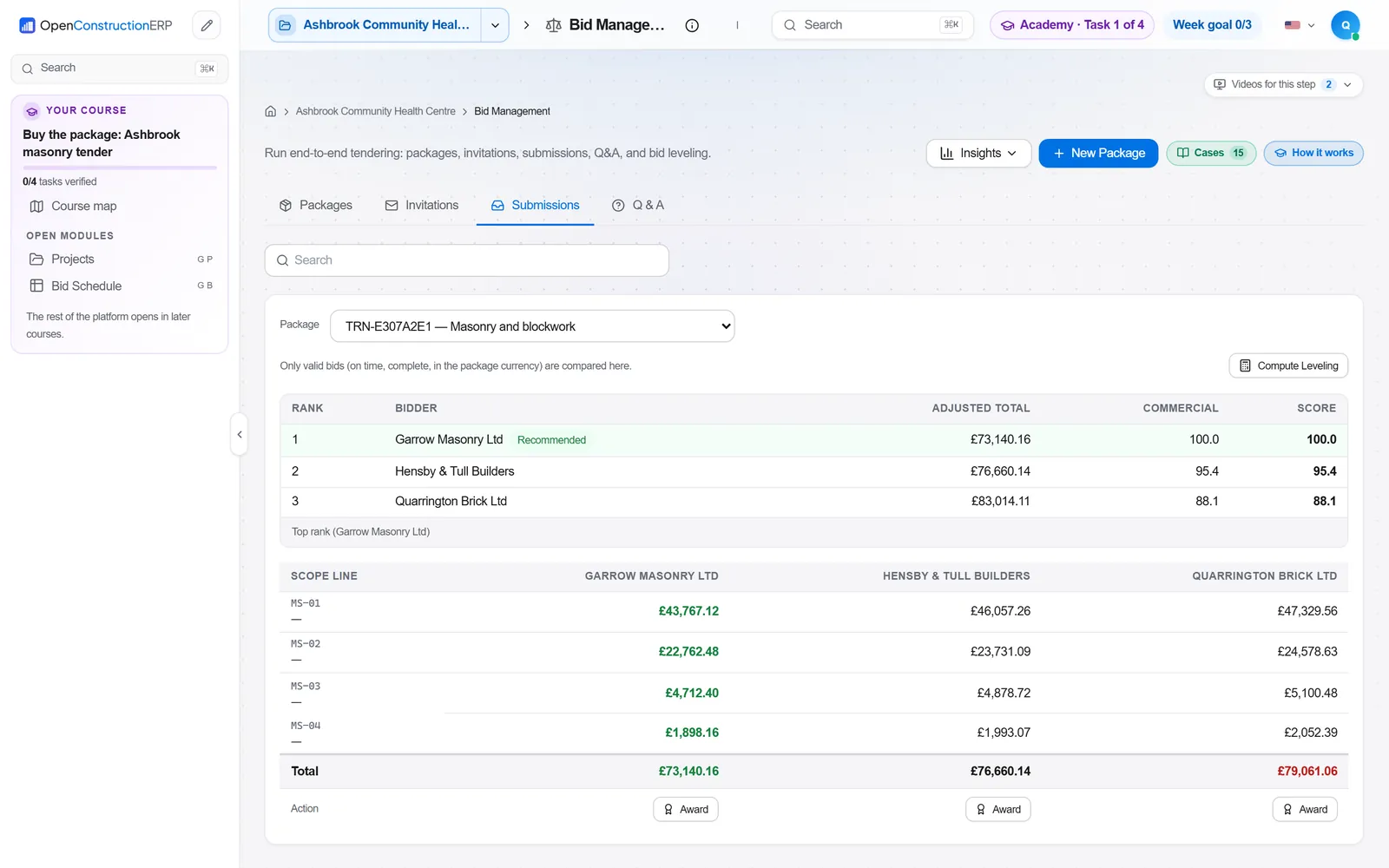
- Output
- Tender package, bid comparison and award recommendation
- Module
- Tendering and procurement
- Documents
- Standards and references
What it is
Tendering is the process of inviting prices for work on equal terms and choosing a supplier. It covers preparing the tender package, prequalifying bidders, issuing documents, answering queries, receiving bids and comparing them on a like-for-like basis. It is used by clients appointing main contractors and by contractors letting packages to subcontractors.
A fair and well-documented tender produces a price that reflects the scope, and a contract that can be managed. Poor packages lead to qualified bids, gaps between trades and later claims. Bid levelling, where each bid is adjusted for exclusions and errors so they can be compared, is where much of the commercial value is won or lost. Public clients must also follow procurement law on transparency and equal treatment.
Who does it
- Procurement or tender manager
- Runs the process, issues documents, manages the timetable and the question log.
- Quantity surveyor or estimator
- Prepares the pricing document, levels the bids and reports on value.
- Design team
- Answers technical queries and reviews alternative proposals.
- Bidders
- Price the work, raise queries and state any qualifications.
- Client or commercial director
- Approves the award recommendation.
How it runs
Define the package
Set the scope, interfaces with other packages, contract form and pricing document.
Prequalify bidders
Check experience, capacity, financial standing and safety record before inviting bids.
Issue the invitation
Send the same documents and deadline to all bidders and record what was sent.
Manage queries
Answer questions in writing and share answers with all bidders, issuing addenda where scope changes.
Receive and open bids
Collect bids by the deadline and record them under controlled conditions.
Level and compare
Adjust each bid for exclusions, qualifications and arithmetical errors, then compare on equal scope.
Recommend and award
Prepare the recommendation, clarify remaining points and issue the award.
How it differs by country
- United Kingdom
- Public procurement is governed by the Procurement Act 2023, in force since February 2025. Main contracts are commonly JCT or NEC4, and two-stage tendering is frequent on larger building projects.
- Germany
- Public works are tendered under VOB/A, with open procedure (offenes Verfahren) as the normal route above thresholds. Bills are issued and returned in GAEB format, and the contract terms follow VOB/B.
- France
- Public tenders follow the Code de la commande publique, usually with separate lots by trade. Bidders price the DPGF or BPU and DQE against the CCTP, and the CCAP sets the administrative terms, often referring to the CCAG-Travaux.
- United States
- Public work is usually let by sealed competitive bid to the lowest responsive and responsible bidder, often with bid bonds. Private work is often negotiated, and contracts commonly use AIA or ConsensusDocs forms.
- International
- Multilateral development banks require their own procurement rules, often with FIDIC-based conditions. FIDIC also publishes guidance on procurement procedures for its contract suite.
Common mistakes
- Issuing packages with unclear scope boundaries between trades, so some work is priced twice and some not at all.
- Answering a query for one bidder without sharing it with the others.
- Comparing headline prices without levelling for exclusions and qualifications.
- Allowing too little tender time for the complexity of the package.
- Failing to record the reasons for the award, which weakens the client's position if challenged.
In OpenConstructionERP
Module: Tendering and procurement
OpenConstructionERP handles tenders through the Tendering module for bid package management, distribution, collection and comparison. Bid Management covers invitations, question and answer, submissions, levelling and award, while RFQ & Bidding supports smaller request-for-quotation rounds. Subcontractor Management holds prequalification and rating so that only suitable firms are invited. The Contract Types Engine records whether the resulting contract is lump-sum, GMP, cost-plus, time and materials, unit-price or design-build.
Tendering · Bid Management · RFQ & Bidding · Subcontractor Management · Contract Types Engine
The app runs at openconstructionacademy.com/app for course learners.
Free videos
 7:26Licitação de obras públicas: proposta e regra dos 75%Português
 1:58Избор на подизпълнител: сравнение на оферти по цена и срокБългарски
 4:23Tender Work to SubcontractorsEnglish
 5:03工程量清单投标价怎么算:四大块与增值税陷阱中文
 5:20暂估价招标:比价、清标、定标,最低价未必最省中文
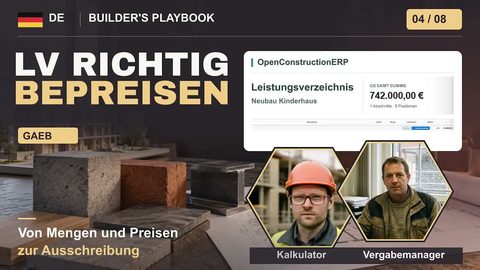 3:40Kostenvoranschlag und GAEBDeutsch
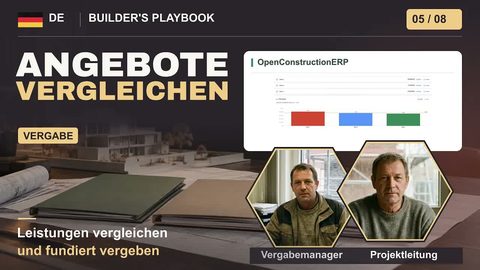 3:43Vergabe im BauwesenDeutsch
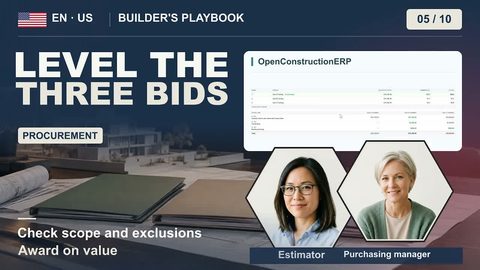 3:10Bid Leveling: Three Quotes, One JobEnglish
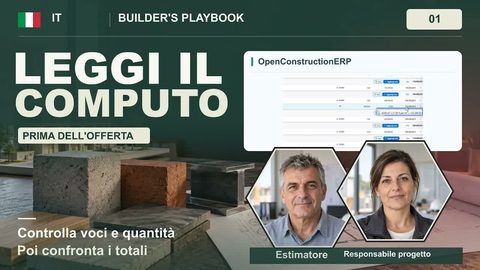 4:25Come leggere il computo metrico prima di fare l'offertaItaliano
18 videos
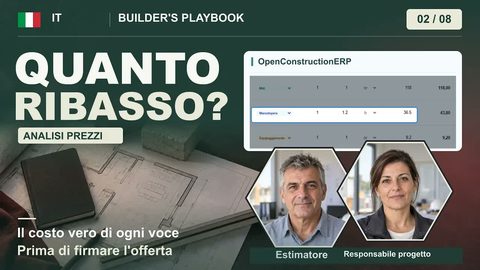 4:39Ribasso d'offerta: analisi prezzi e margineItaliano
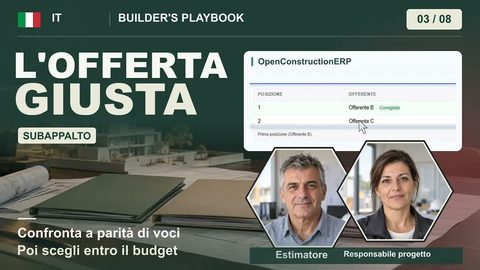 4:59Subappalto: confrontare le offerte e scegliere l'impresaItaliano
 5:34GAEB-Dateien kontrolliert austauschenDeutsch
 3:04Angebote prüfen und Vergabe vorbereitenDeutsch
 4:30Soumissions et BSDQFrançais
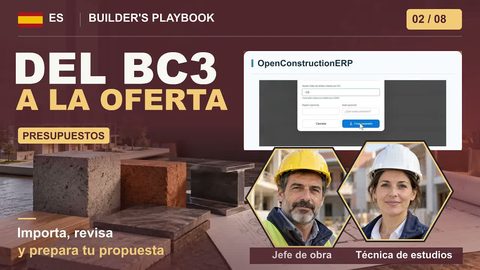 2:40Importar BC3 y preparar una oferta de obra: PEM, gastos y bajaEspañol
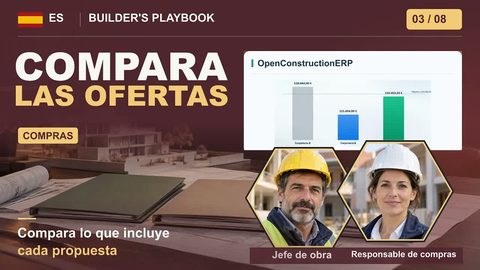 2:10Comparativo de ofertas de obra: precio, alcance y adjudicaciónEspañol
 5:53How to Price a Construction Tender (NRM 2)English
 6:01How to Compare Subcontractor BidsEnglish
Courses
- Free
 Buy the package: Ashbrook masonry tender1. Record a returned bid and check its arithmetic
- Professional
 Brannock Partners: Chicago office fit-out bid3. Bid day: level the HVAC scope sheets
- Professional
 Haselmoor Los 05: Leistungsverzeichnis aus GAEB X83 bearbeiten und ausfüllen1. GAEB X83 einlesen und das Leistungsverzeichnis prüfen
- ProfessionalУчилище в Белостен: обществена поръчка по ЗОП, чл. 72 и изменение на договора1. Отваряне на ценовите предложения: стойност без ДДС
- FreeTallowgate Works: tender to first valuation3. Level the dry lining bids and award
- FreeCorvennick Building fit-out: bid to first change order3. Level the drywall bids and award
- FreeKita Erlengrund: vom LV zum ersten Nachtrag3. Preisspiegel Erdarbeiten und Vergabe an den Nachunternehmer
- Free
 Groupe scolaire de Landrevel : de l'étude de prix à l'avenant3. Tableau comparatif et choix du sous-traitant façade
- Free
 Palestra della scuola di Valcerasa: dal computo metrico alla variante3. Confrontare le offerte di subappalto del pavimento sportivo
- Free
 Centro cívico de Valdelagua: del BC3 al precio contradictorio3. Comparativo de subcontratas de cubierta a igualdad de alcance
- Free
 Przedszkole w Brzozowej Woli: od kosztorysu do aneksu3. Wybór podwykonawcy docieplenia: porównanie ofert netto
- FreeУчилище в Белостен: КСС, акт обр. 19 и непредвидени СМР3. Подизпълнител за дограмата: сравнение на оферти в евро
- FreeUBS Vila Esperança: orçamento SINAPI, encargos sociais e BDI4. Propostas: inexequibilidade e limite do orçamento
Checklists
Short checklists that go with this process.
Practise it in OpenConstructionERP
The free videos explain the process. The full course lets you run it yourself in the ERP, task by task.