

































Stage 3 of 7 · Estimate
Estimating and bills of quantities
Turn measured quantities into a priced bill of quantities and a tender sum.
- ProfessionalEstimate data ETL: import, clean and reconcile cost data +17 more
- Free videos36 videos
- Output
- Priced bill of quantities and estimate summary
- Module
- Estimating and BOQ
- Documents
- Standards and references
What it is
Estimating turns measured quantities into a price. Each bill position gets a rate, built up from labour, plant, materials and subcontract costs, and the estimate then adds preliminaries, allowances, risk and margin. Estimates are prepared at several stages, from an order-of-magnitude figure on floor area to a fully priced bill for tender, and each stage carries a different level of accuracy.
The estimate decides whether a project goes ahead and at what price a contractor bids. It becomes the basis for the budget, the cash flow forecast and the valuation of variations. A clear basis of estimate, stating inclusions, exclusions and assumptions, protects both sides when the scope is later questioned. Feedback from actual site costs into future rates is what makes an estimating team more accurate over time.
Who does it
- Estimator
- Builds rates, prices bill positions and prepares the estimate summary.
- Quantity surveyor or cost manager
- Prepares cost plans for the client and checks contractor prices against them.
- Planner
- Provides the programme that time-related preliminaries and resource levels depend on.
- Commercial or estimating manager
- Reviews risk, allowances and margin and approves the final figure.
- Specialist subcontractors
- Supply quotations for packages the main contractor does not price in-house.
How it runs
Confirm scope and basis
Record the documents priced, inclusions, exclusions and assumptions before pricing starts.
Structure the bill
Set out the bill hierarchy to the required method and classification, using measured quantities from takeoff.
Build or select rates
Price each position from cost database items, assemblies or crew rates, adjusted for location and productivity.
Price preliminaries
Split general items into time-related and fixed costs, using the programme duration.
Add allowances and contingency
Record provisional sums, prime cost sums and risk contingency separately from measured work.
Apply markups and roll up
Add overheads and profit and produce the summary that management and the client will see.
Review and adjudicate
Check totals against benchmarks, review key risks and approve the tender figure or cost plan.
How it differs by country
- United Kingdom
- RICS NRM1 sets out order of cost estimates and elemental cost plans for the client side, and NRM2 governs the measured bill. Preliminaries are commonly priced under NRM2 headings, with provisional sums defined or undefined.
- Germany
- DIN 276 defines the stages of cost determination, from Kostenrahmen and Kostenschätzung to Kostenberechnung, Kostenanschlag and Kostenfeststellung, linked to HOAI work stages. Contractors price bills (Leistungsverzeichnis) exchanged in GAEB, and BKI publishes building cost reference data.
- France
- Contractors price the DPGF for lump-sum lots or the BPU and DQE for unit-price contracts. The economiste de la construction prepares cost estimates for the design team at each phase.
- United States
- Estimates are usually organised by CSI MasterFormat divisions, with UniFormat used for early system-level estimates. General conditions and general requirements are priced separately from direct work.
- International
- Under FIDIC Red Book the contractor prices a bill of quantities that is remeasured, while under Yellow and Silver Book design-build and EPC forms the contractor prices a lump sum and carries more quantity risk.
Common mistakes
- Pricing without a written basis of estimate, leaving no record of what was included when scope is disputed.
- Including waste in both the quantity and the rate.
- Pricing preliminaries as a percentage rather than from the programme, which hides the cost of delay.
- Burying contingency inside rates, so it cannot be managed or drawn down transparently.
- Using national average rates without adjusting for location, market conditions and the date of the price.
- Never comparing completed project costs with the estimate, so the same errors repeat.
In OpenConstructionERP
Module: Estimating and BOQ
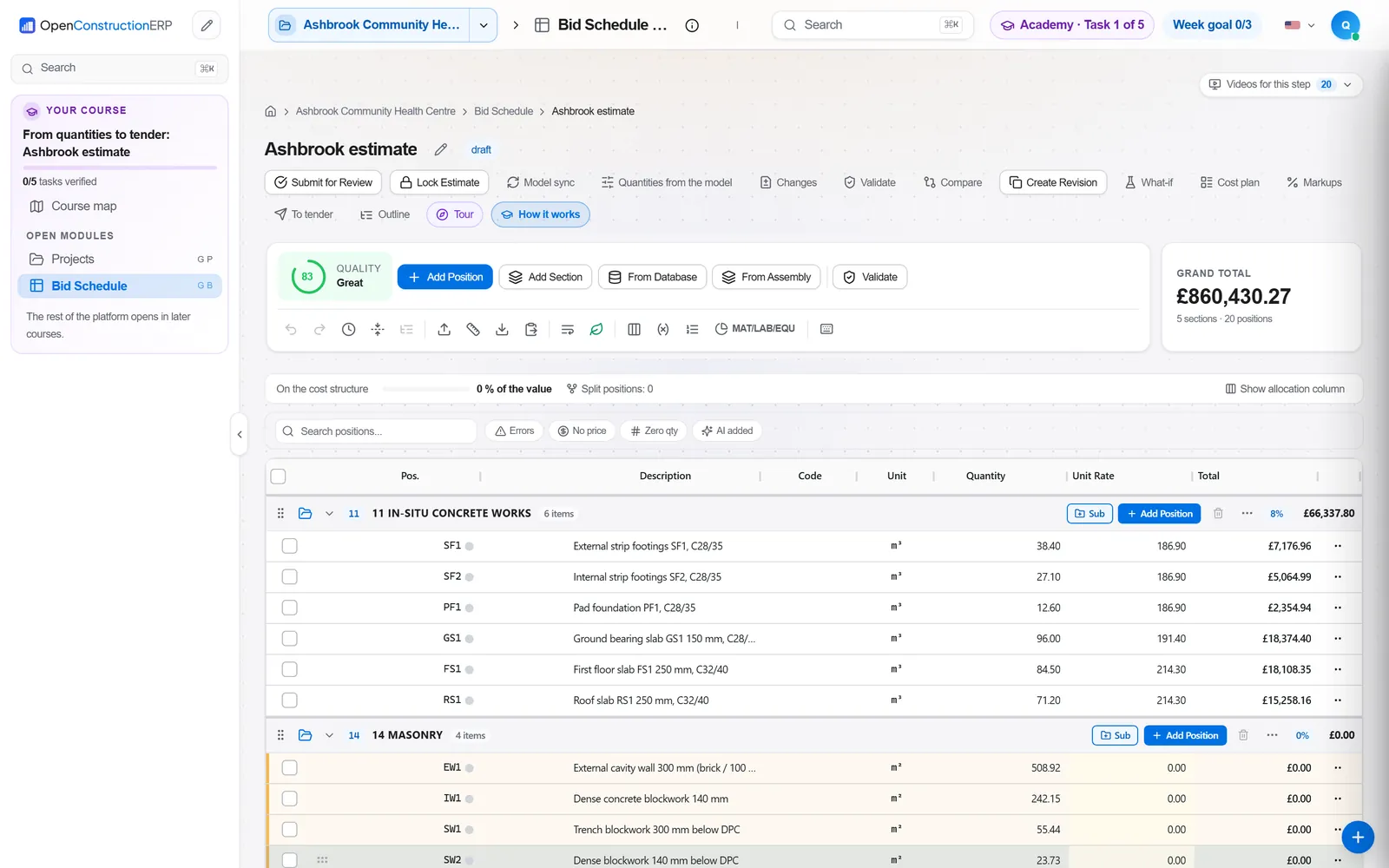
In OpenConstructionERP the Bill of Quantities module is the hierarchical BOQ editor where positions, quantities and roll-up live. Assemblies & Calculations and Labor & Crew Rates build composite rates, and Estimating Methodologies supplies per-country hierarchies and cascading markups. Preliminaries prices time-related and fixed items, Allowances & Contingency tracks provisional sums and contingency, and Estimate Rollup gives the headline figure. Conceptual Estimate covers early order-of-magnitude stages, Basis of Estimate drafts inclusions and exclusions, and Post-calculation reconciles actuals into productivity factors for the next job.
Bill of Quantities · Assemblies & Calculations · Labor & Crew Rates · Estimating Methodologies · Preliminaries · Allowances & Contingency · Estimate Rollup · Conceptual Estimate · Basis of Estimate · Post-calculation
The app runs at openconstructionacademy.com/app for course learners.
Free videos
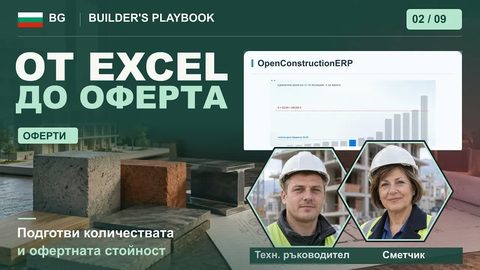 1:57КСС и оферта: импорт от Excel, проверка на цените и ДДСБългарски
 9:35Orçamento de obra pública: SINAPI, composição e BDIPortuguês
 4:49Price a Construction JobEnglish
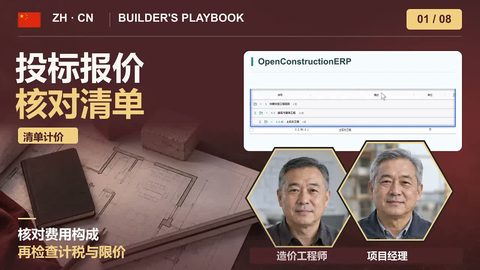 5:03工程量清单投标价怎么算:四大块与增值税陷阱中文
 3:40Kostenvoranschlag und GAEBDeutsch
 8:30How to Read a Construction Estimate Line by LineEnglish
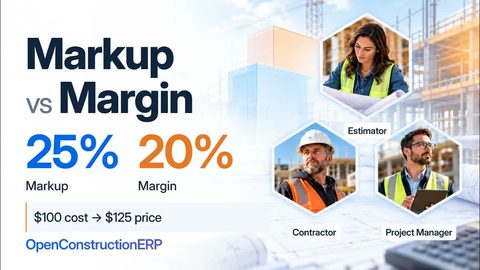 7:36Markup vs Margin in ConstructionEnglish
 3:54Construction Pricing: Overhead, Profit & ContingencyEnglish
 4:17Estimer un projet de constructionFrançais
36 videos
 2:40Importar BC3 y preparar una oferta de obra: PEM, gastos y bajaEspañol
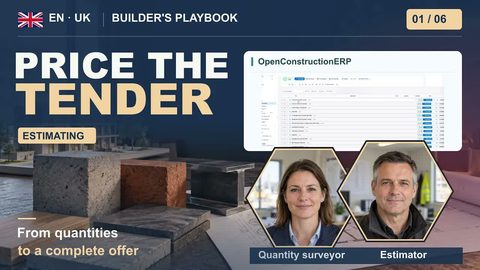 5:53How to Price a Construction Tender (NRM 2)English
 7:26Licitação de obras públicas: proposta e regra dos 75%Português
 7:32Nota fiscal de obra (NFS-e): retenções de ISS e INSSPortuguês
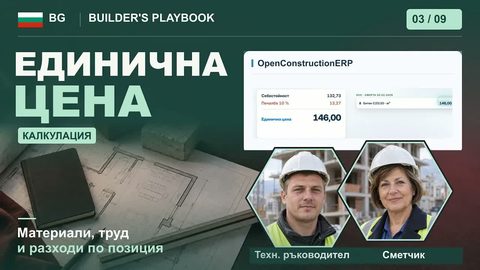 2:14Анализ на единична цена: материали, труд, механизация и печалбаБългарски
 5:06Budget de chantier : justifier chaque coûtFrançais
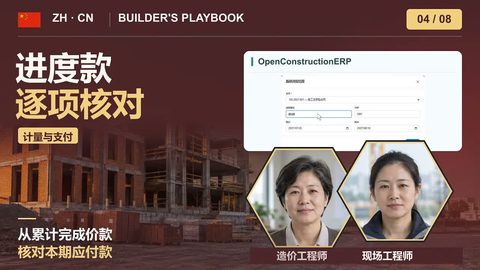 5:15进度款怎么算:干了361万,为什么只到账252.7万中文
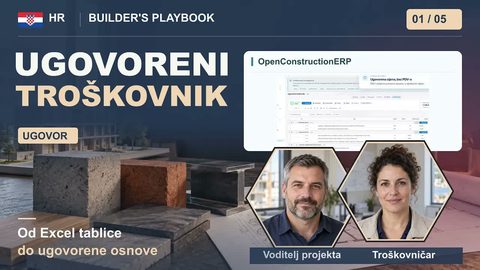 4:10Ugovoreni troškovnik: uvoz iz ExcelaHrvatski
 4:28Ulazni računi povezani s troškovnikomHrvatski
 3:45Kostenrahmen nach DIN 276 erstellenDeutsch
 3:28Kostenschätzung nach DIN 276 erstellenDeutsch
 3:36Kostenberechnung nach DIN 276Deutsch
 7:14Quantity Takeoff from PDF DrawingsEnglish
 8:08From a Revit or IFC Model to a Cost EstimateEnglish
 8:08Excel vs Estimating SoftwareEnglish
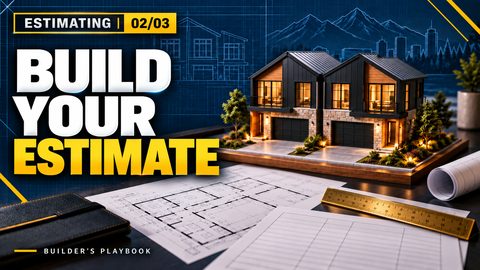 4:47Build a Construction Estimate Step by StepEnglish
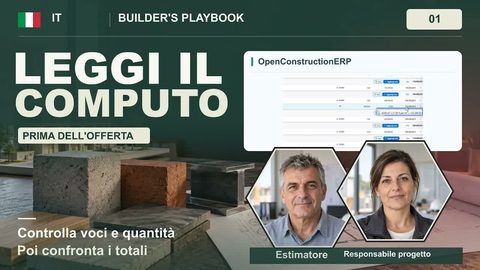 4:25Come leggere il computo metrico prima di fare l'offertaItaliano
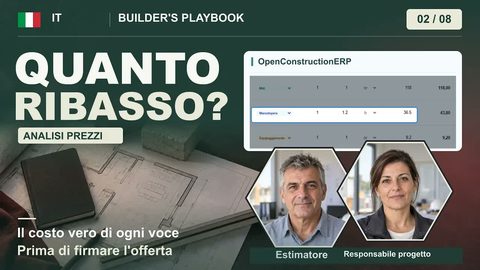 4:39Ribasso d'offerta: analisi prezzi e margineItaliano
 5:02Ein Leistungsverzeichnis aufbauenDeutsch
 6:36Einheitspreise und Kosten nachvollziehenDeutsch
 5:34GAEB-Dateien kontrolliert austauschenDeutsch
 7:35Kostenquellen und Ressourcen anpassenDeutsch
 10:14Vom vollständigen LV zur KostenbasisDeutsch
 3:46Démarrer avec OpenConstructionERP en françaisFrançais
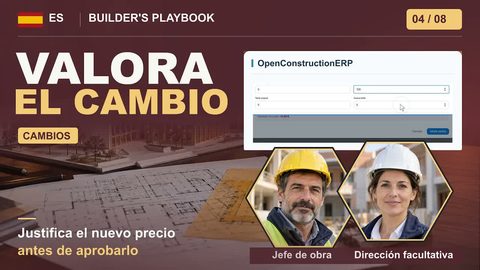 2:09Precio contradictorio: valorar y aprobar un cambio de obraEspañol
 2:43Obra privada: certificación, retención del 5 % y facturaEspañol
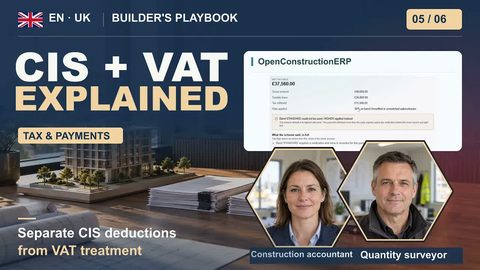 6:34CIS Deductions and VAT Reverse ChargeEnglish
Courses
- Professional
 Estimate data ETL: import, clean and reconcile cost data1. Import a subcontractor's offer: read the warnings, remove the duplicate, reconcile the total
- FreeFrom quantities to tender: Ashbrook estimate1. Build a concrete unit rate from resources
- FreeКоличествена сметка и КСС: училище в Белостен1. Фасада: площ за топлоизолация от размерите минус отворите
- Professional
 Hollis Yard: wood-frame multifamily takeoff to schedule of values4. From wall LF to board, batts, sheathing and studs
- ProfessionalBrannock Partners: Chicago office fit-out bid1. Scope by division: general conditions vs general requirements
- ProfessionalCentro Comunitario Las Jacarandas: presupuesto por precios unitarios1. FASAR y análisis de precios unitarios de albañilería
- Professional
 Verwaltungsgebäude Haselmoor: Kostenberechnung nach DIN 2761. Kostenberechnung KG 300 bis zur 3. Ebene
- ProfessionalHaselmoor Los 05: Leistungsverzeichnis aus GAEB X83 bearbeiten und ausfüllen2. Leistungsverzeichnis ausfüllen: Einheitspreise kalkulieren
- ProfessionalAI-assisted take-off: verify before you price1. Scale first: an A3 copy of an A1 drawing, and the area the AI chose
- FreeTallowgate Works: tender to first valuation1. Price the dry lining package
- FreeCorvennick Building fit-out: bid to first change order1. Price the estimate
- FreeKita Erlengrund: vom LV zum ersten Nachtrag1. LV kalkulieren: Titel 04 Mauerarbeiten auf Einzelkosten
- Free
 Groupe scolaire de Landrevel : de l'étude de prix à l'avenant1. Établir le déboursé sec de la DPGF du lot 02
- Free
 Palestra della scuola di Valcerasa: dal computo metrico alla variante1. Completare il computo metrico estimativo della palestra
- Free
 Centro cívico de Valdelagua: del BC3 al precio contradictorio1. Precios descompuestos y PEM del centro cívico
- Free
 Przedszkole w Brzozowej Woli: od kosztorysu do aneksu1. Kalkulacja szczegółowa: ceny jednostkowe trzech pozycji kosztorysu ofertowego
- FreeУчилище в Белостен: КСС, акт обр. 19 и непредвидени СМР1. Анализи на единични цени: три позиции от КСС
- FreeUBS Vila Esperança: orçamento SINAPI, encargos sociais e BDI1. Encargos sociais, custo horário e a primeira composição
Checklists
Short checklists that go with this process.
Practise it in OpenConstructionERP
The free videos explain the process. The full course lets you run it yourself in the ERP, task by task.